
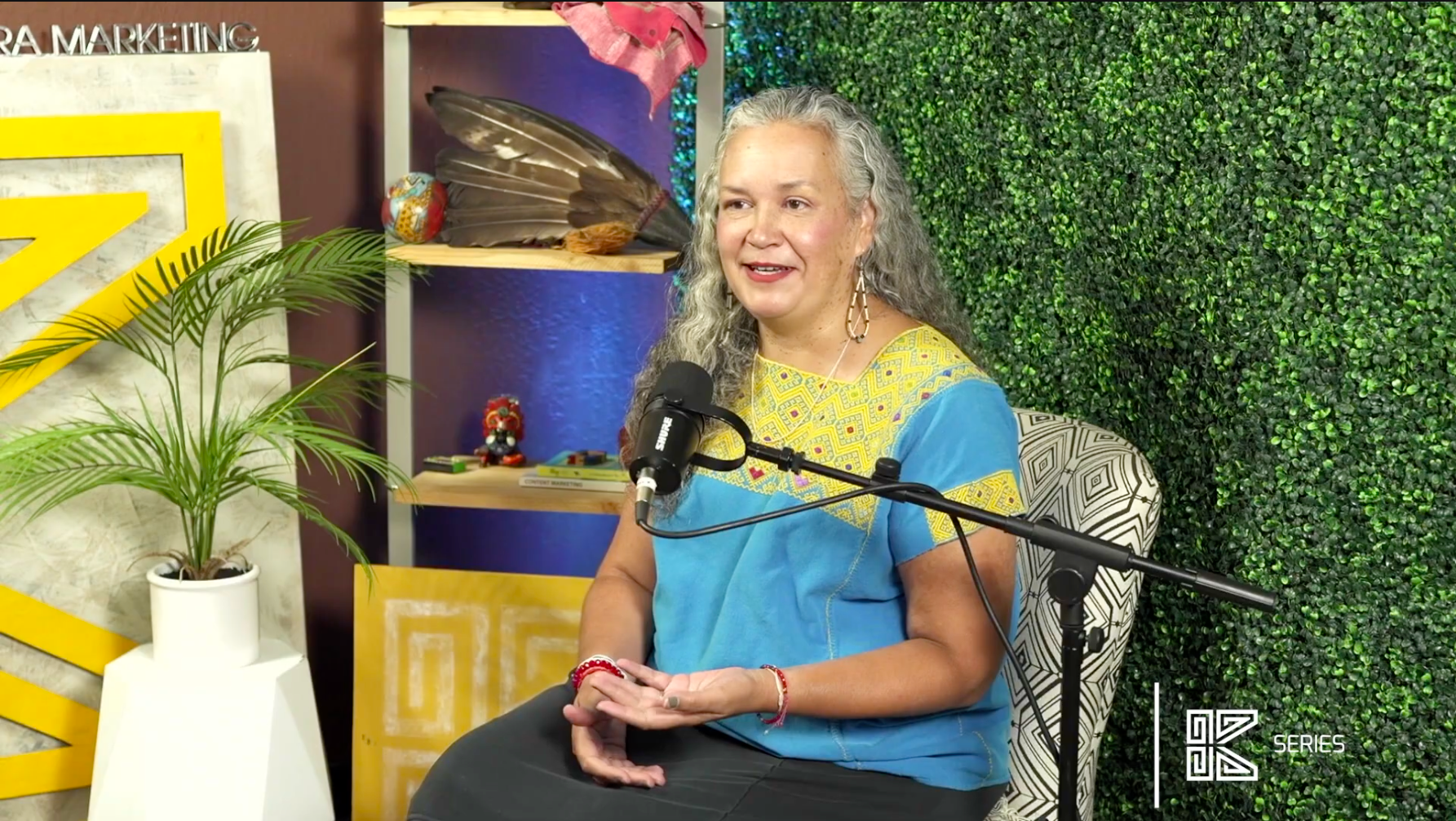
People.Culture.Community series set at EMLN Headquaters
We all carry stories with us. Sometimes they’re found in the things we keep, the things we inherit, and the things that connect us to the people and places that have shaped our lives.
For Tamara Alvarado, three meaningful items offer a glimpse into a life grounded in cultural identity, spiritual practice, and service to community.
A co-founder and leader of Calpulli Ocelocihuatl Aztec Dance in San José, Tamara describes herself as a Chicana, a mother, a wife, and a cultural organizer. She first came to the Bay Area to attend Stanford University as the first person in her family to go to college. Nearly 30 years later, San José has become home and the place where much of her cultural and community work continues.
Each item she brought tells a different part of her story. Together, they reveal a common thread: the responsibility she feels to give back to the communities that have given her so much.

YOU. The responsibility of carrying knowledge forward.
The first item Tamara chose was a poposhcomitl, a traditional incense burner she uses in her work as a saumadora. Filled with copal resin placed over burning charcoal, it produces smoke used in ceremonial practices for cleansing and spiritual support.
For Tamara, the item represents more than a personal connection to tradition. It symbolizes a responsibility she takes seriously—one that came through years of training with her teachers in Mexico and continues through her service to others.
“To me, I’m tied to the fire.”
As a saumadora, Tamara describes her role as one connected to the spiritual well-being of her community. When people approach her seeking cleansing or support through ceremony, she sees that as part of the work she has been entrusted to do.
The poposhcomitl becomes a reminder that there is still work to do—and that carrying knowledge comes with a responsibility to use it.
“It’s not for me to gatekeep.”
CULTURE. The pride that stays with us.
The second item was Tamara’s sonaja, a rattle used in traditional Aztec dance. Its meaning reaches back much further than her work today.
As a young child, Tamara’s parents took her to Chicano Park in Barrio Logan, San Diego, where she watched Aztec dancers and experienced the sounds of the rattles, the drums, and the scent of copal. Her parents were immigrants who wanted to connect their family to the culture around them. Those visits helped plant a seed that would continue to grow throughout her life.
Tamara remembers how those early experiences shaped her understanding of identity and belonging. Her parents may not have known all the language surrounding Chicanismo and Chicanidad, but they understood the importance of pride and making sure their children knew who they were.
“What can’t fall apart is our identity. And our pride.”
Today, she sees a connection between those childhood memories and the children who watch Aztec dancers at cultural events in San José. When she sees a young child looking on in wonder, she recognizes something of her younger self.
The spaces where culture is practiced and shared can become places where children begin to understand their own worth. For Tamara, that understanding has been a source of strength, especially in moments when she has felt that others did not see her as a whole person.
Knowing who she is and where she comes from has helped her stand firm in her place in society.
Her sonaja is an extension of her when she dances, but it is also a reminder of what her parents passed on to her—and what she hopes to help pass on to the next generation.
COMMUNITY. Protection, resistance, and responsibility.
For her third item, Tamara brought an eagle wing gifted to her by a friend and brother on her 50th birthday.
She sees the wing as a symbol of protection. Like a bird extending its wings to shelter its young, it represents the responsibility to look out for others. But in her ceremonial practice, the raised wing also carries a message of resistance.
Tamara connects that gesture to the history of Indigenous peoples whose cultural and spiritual practices were suppressed through colonization. Raising her arm with the wing becomes a way to affirm the continued presence of those traditions and the people who carry them forward.
“It’s a wing of protection, but it’s a wing of resistance.”
That sense of responsibility extends beyond ceremony. Tamara describes how Aztec dance groups have joined community actions, including San José’s May Day marches, bringing drums, copal, and ceremonial presence into spaces where people are organizing for change.
She also sees service in everyday acts of care. Supporting a neighbor, sharing food, showing up at a march, or responding when a community calls for ceremony can all be meaningful ways to contribute.
Her parents modeled that spirit through their own hard work and generosity.
As Tamara puts it, “Si tú tienes, tienes que dar”—if you have, you have to give.
For her, the wing represents a commitment to protect, support, and encourage others to recognize their own voice and responsibility within the community.
Three items. One story.
When asked what the three items reveal about her together, Tamara returns to the idea of giving back.
Her answer brings the objects into focus: the poposhcomitl and its connection to spiritual well-being, the sonaja and the cultural pride instilled by her parents, and the eagle wing as a symbol of protection and resistance.
Each reflects a different part of her life, but all point toward the same purpose.
“I am in service too, because I have received a lot.”
That service continues through her work with community organizers, cultural events, and ceremonial gatherings. Looking ahead, Tamara hopes to keep creating opportunities for people to encounter these traditions, learn from them, and find their own connections to culture and community.
For her, the work is not simply about preserving practices within an existing circle. It is also about making space for others to discover what those practices might mean in their own lives.
The three items tell a story of someone shaped by family, grounded in identity, and committed to the well-being of others. They also remind us that culture is not only something we inherit. It is something we practice, share, and carry forward through the ways we show up for one another.
Watch Tamara Alvarado’s full conversation in People.Culture.Community., a Kooltura Series exploring the people, traditions, and communities shaping our cities.
